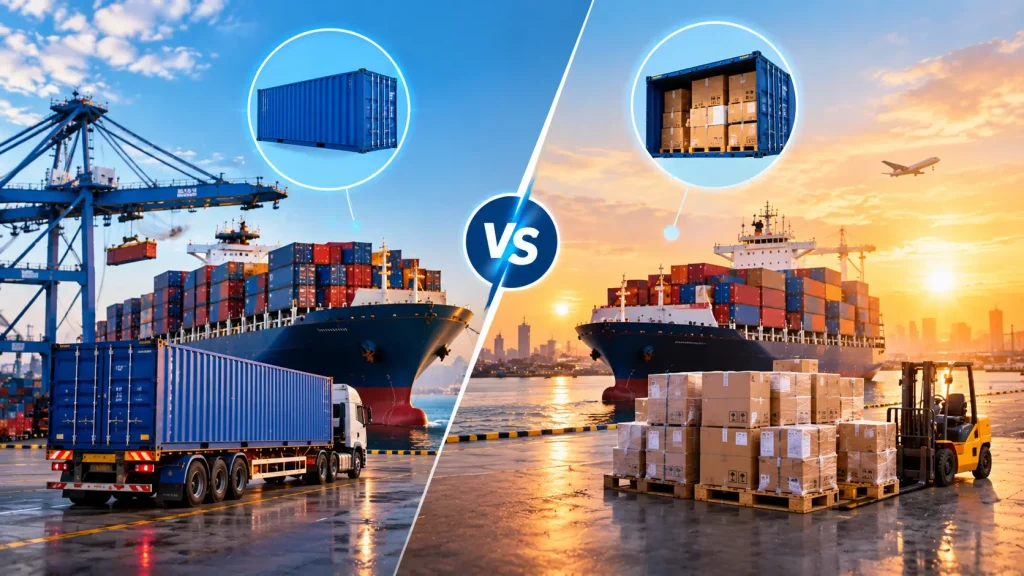
LCL usually costs less when your cargo is under roughly 12 to 15 CBM, according to Global Corporate Logistics, because you pay only for the space you use. Above that range, FCL tends to win on cost per CBM. LCL also adds about 5 to 10 days to transit, per Lineup.
At what volume does FCL become cheaper than LCL?
Around 12 to 15 CBM for most routes. CBM means cubic metres, the amount of space your cargo takes up. Global Corporate Logistics and Drip Capital both put the practical break-even point in that range, while Lineup places it between 15 and 20 CBM and says a full container is generally cheaper above 20.
The reason is simple. Drip Capital explains that FCL is a flat rate per container, while LCL is charged per CBM or per ton, whichever is greater. Each extra CBM adds to your LCL bill, but the container price stays put. Global Corporate Logistics lists a standard 20ft container at about 28 to 30 CBM and a 40ft at about 58 to 60 CBM, so a 15 CBM load fills roughly half a 20ft box.
Not sure of your volume? Our guide on how to calculate CBM walks through it.
Why does the break-even point move?
FreightFigures says it shifts with the market. When carriers are competing hard for cargo, FCL rates soften and the break-even can fall to around 8 to 10 CBM. When vessel space is tight, it can climb to 20 to 25 CBM. Dense, heavy cargo also changes things: LCL uses a weight or measure rule, so heavy goods can trigger the weight charge and push LCL costs above what volume alone suggests.
What does a real cost comparison look like?
Small loads favour LCL clearly, mid-size loads are close, and large loads favour FCL. FreightFigures gives an example where 6 CBM costs roughly $840 by LCL against $2,000 for a container, while 14 CBM costs about $1,960 by LCL, which is almost level with the container.
Global Corporate Logistics shows the same pattern on a China to Felixstowe example: about £650 for 8 CBM by LCL, then £1,150 for LCL against £1,200 for FCL at 15 CBM, and £1,500 for LCL against the same £1,200 for FCL at 20 CBM.
You can also work out your own crossover. Cargomath’s formula is the container price, minus fixed LCL fees, divided by the LCL rate per CBM. Using its sample figures ($2,400 container, $450 fixed fees, $110 per CBM), the break-even lands at about 17.7 CBM. These are examples from other lanes, not Australia to Nigeria, so ask Postkodes for live rates on your route.
What hidden fees change the math on LCL?
Fixed handling charges. Cargomath points out that LCL carries local charges (CFS, handling and bill of lading fees) whatever your shipment size. Global Corporate Logistics adds that LCL has a minimum charge of around 1 CBM, plus consolidation, deconsolidation and terminal handling fees.
The container freight station (CFS) is the warehouse where LCL cargo is combined with other shippers’ goods at origin and split apart again at destination. Drip Capital notes that terminal handling is included in an FCL container rate but charged per CBM on LCL. TEU Inc warns that storage, CFS and destination handling can add up fast. That is why Global Corporate Logistics says FCL can sometimes beat LCL between 8 and 15 CBM once every add-on fee is counted.
How much longer does LCL take than FCL?
About 5 to 10 days longer, according to Lineup, because your cargo goes through CFS handling at both ends. It waits to be consolidated with other freight, then waits again to be unpacked and sorted at the destination.
TEU Inc adds that shared handling also raises damage risk slightly, while FCL keeps your goods untouched from origin to destination. If your cargo is fragile, high value or tied to a deadline, that can outweigh a small saving on freight.
How long does it take to ship from Australia to Nigeria?
Typically 5 to 10 weeks door to door by sea. PackSend quotes 5 to 9 weeks for FCL and LCL sea freight to Nigeria. Widoph Logistics quotes roughly 5 to 10 plus weeks port to port, and that figure excludes customs and inland delivery.
Customs clearance comes on top. SGK Global reports 2 to 5 business days in Nigeria with complete documentation, and 3 to 7 business days for sea cargo at Apapa or Tin Can Island when the port is busy. Fluent Cargo’s route data shows sailings between Australia and Nigeria usually include at least one transshipment stop.
My advice: if cargo has to be in Nigeria by a fixed date, work back from the long end of the range, 10 weeks plus customs days. If you ship LCL, expect to sit toward that long end, since it adds 5 to 10 days (Lineup). All of these are typical ranges, so confirm timing with Postkodes before you book.
What is the step by step process for each option?
FCL and LCL follow the same route but differ at the start and end.
FCL
- You book a container size (20ft or 40ft).
- The container is loaded with your cargo only, then sealed.
- It moves to the Australian port and sails, usually with a transshipment stop.
- It arrives at a Nigerian port such as Lagos, Apapa or Tin Can Island and clears customs.
- It is delivered to you as one sealed unit.
LCL
- You book by CBM or weight.
- Your cargo goes to the CFS and is combined with other shippers’ freight.
- The shared container sails, usually with a transshipment stop.
- At the Nigerian port it is unpacked and sorted, which is the extra step that adds time.
- Your portion clears customs and moves on to delivery.
How do you track an FCL or LCL shipment?
With FCL, you track by container number and bill of lading. With LCL, your cargo shares a container, so you track using your own House Bill of Lading. Frayto confirms that each LCL shipper gets a House Bill of Lading, while the freight forwarder holds the Master Bill of Lading from the shipping line. Make sure the details on your house document match your cargo, because mismatches can hold up customs.
FCL or LCL: which should you choose?
Go by volume first, then by risk and deadline. Global Corporate Logistics gives a clear guide:
- Under 12 CBM: choose LCL.
- Between 12 and 15 CBM: ask for both quotes on an all-in basis.
- Above 15 CBM: FCL is usually cheaper.
Choose FCL at any volume if your goods are fragile or high value, or the deadline is tight. Choose LCL for test orders and regular small restocks where a few extra days won’t hurt.
What mistakes make people overpay?
Comparing base freight rates only is the biggest one. The CFS, handling and destination fees are what flip the result.
Guessing your CBM is another. A rough estimate can put you on the wrong side of the break-even point.
Assuming a half empty container is wasteful also costs money. Cargomath notes that FCL can still win with unused space if LCL’s variable and fixed charges add up to more than the flat container price.
Booking LCL for dense cargo is a quieter mistake, because the weight charge can make it dearer than the volume suggests (FreightFigures).
Finally, leaving no buffer for the extra 5 to 10 days that LCL adds can turn a saving into a missed deadline.
How do FCL and LCL compare side by side?
| Factor | FCL | LCL |
|---|---|---|
| Pricing basis | Flat rate per container (Drip Capital) | Per CBM or per ton, whichever is greater (Drip Capital) |
| Best value at | Roughly 12 to 15 CBM and above (Global Corporate Logistics) | Under roughly 12 to 15 CBM (Global Corporate Logistics) |
| Container size | 20ft about 28 to 30 CBM, 40ft about 58 to 60 CBM (Global Corporate Logistics) | Shares a container with other shippers |
| Extra transit time | None from consolidation | 5 to 10 days (Lineup) |
| Damage risk | Lower, single shipper (TEU Inc) | Slightly higher, shared handling (TEU Inc) |
| Australia to Nigeria by sea | 5 to 10 weeks door to door (PackSend, Widoph Logistics) | Likely toward the longer end, as LCL adds 5 to 10 days (Lineup) [estimate, confirm with Postkodes] |
Frequently asked questions
At how many CBM does FCL become cheaper than LCL?
Most sources put it at about 12 to 15 CBM. Global Corporate Logistics and Drip Capital both use that range, while Lineup places it between 15 and 20 CBM. Market rates shift it, so compare both quotes when you’re close.
Is LCL always cheaper for small shipments?
Usually, but not always. LCL has a minimum charge of around 1 CBM plus consolidation and handling fees, according to Global Corporate Logistics. For cargo between 8 and 15 CBM, FCL can sometimes cost less once every add-on fee is counted.
How much longer does LCL take?
About 5 to 10 days longer than FCL, according to Lineup. The extra time comes from the container freight station stages, where cargo is combined at origin and split apart again at destination, before it can move on to you.
How big is a 20ft or 40ft container in CBM?
Global Corporate Logistics lists a standard 20ft container at about 28 to 30 CBM and a 40ft container at about 58 to 60 CBM. Your usable space depends on how the cargo is packed, so leave some margin when planning.
Does FCL have a lower damage risk?
Generally yes. TEU Inc notes FCL has lower damage risk because a single shipper’s cargo stays sealed from origin to destination, while LCL goes through shared handling at the consolidation and deconsolidation stages.
How long does sea freight from Australia to Nigeria take?
PackSend quotes 5 to 9 weeks, and Widoph Logistics quotes roughly 5 to 10 plus weeks port to port, excluding customs and inland delivery. SGK Global adds 2 to 7 business days for Nigerian customs clearance. Confirm exact timing with Postkodes.
What should you do next?
Measure your cargo in CBM first. If it’s under about 12, price LCL. If it’s over about 15, price FCL. In between, ask for both quotes with every fee included, and add a buffer for the extra days LCL takes.
When you’re ready to compare real numbers for your route, Postkodes’ sea freight services can quote both options, and our guide to LCL shipping covers the shared container side in more detail.