
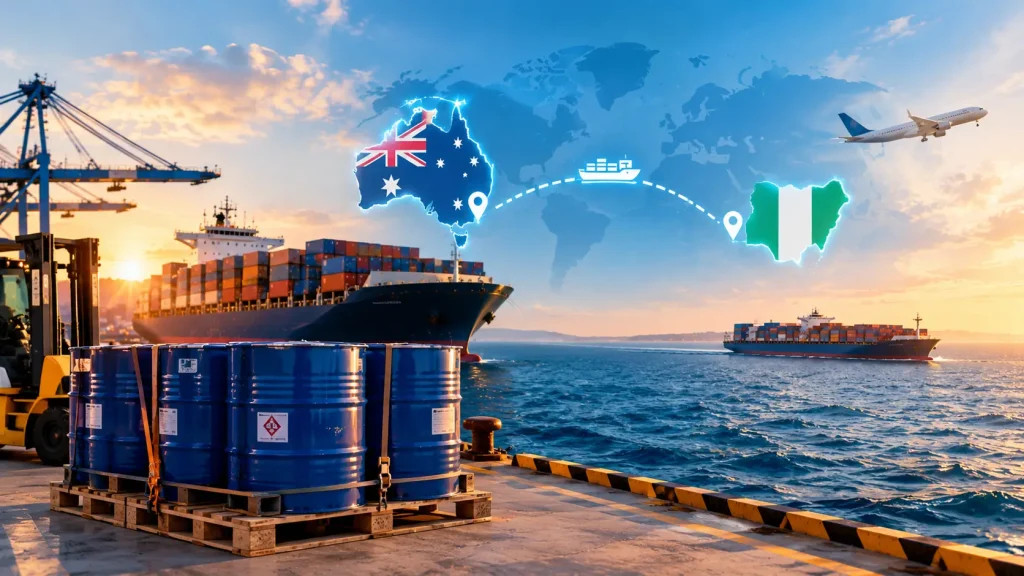
Sea freight from Australia to Nigeria generally takes 5 to 10 weeks door to door, according to Australia based freight forwarders PackSend and Widoph Logistics. Air freight is faster, at roughly 4 to 14 business days depending on whether you choose express or standard service. Nigerian customs clearance adds 2 to 7 business days on top of transit time, based on data from Nigeria focused logistics guide SGK Global.
How long does it take by sea
Sea freight from Australia to Nigeria takes 5 to 10 weeks door to door in most cases. PackSend, which ships directly from Sydney and Melbourne to Lagos, Abuja, and Port Harcourt, quotes 5 to 9 weeks for FCL and LCL sea freight. Widoph Logistics, which specialises in this same corridor, quotes roughly 5 to 10 plus weeks port to port, noting that figure excludes customs and inland delivery.
Route planning tool Fluent Cargo breaks this down further using live shipping line data. The fastest ocean route it tracks runs from Tin Can Island in Lagos to Sydney in about 37 days, with two transshipments, on vessels departing roughly every one to two weeks. A second route, from Lekki to Fremantle, runs about 40 days with one stop. Both figures cover ocean transit only. They don’t include pickup on the Australian side, port dwell time once the barrel lands in Nigeria, or customs clearance.
Put together, a realistic sea freight window looks like this: pickup and consolidation of a few days, ocean transit of roughly 37 to 40 days including a transshipment stop, then port dwell and customs clearance of several more days to over a week, followed by final delivery. That’s how a roughly 37 day sailing turns into a 5 to 10 week door to door estimate once every stage is counted.
How long does it take by air
Air freight from Australia to Nigeria takes 4 to 14 business days, depending on the service level. PackSend lists two tiers on this route: express air freight at 4 to 8 business days for urgent, time critical shipments, and standard air freight at 8 to 14 business days for heavier consignments where you’re trading a bit of speed for better value. Widoph Logistics gives a similar range of roughly 3 to 8 plus days airport to airport, excluding customs.
A full barrel is heavy and takes up real cargo space, so air freight pricing, which is based on actual or dimensional weight, tends to make this option considerably more expensive than sea freight for a standard household barrel. It’s worth using if the barrel genuinely needs to arrive within one to two weeks, but for most personal shipments sea freight remains the more practical choice.
What affects the timeline
A handful of specific things stretch a barrel shipment beyond the ranges above, and most of them are things you can plan around.
Customs clearance is the biggest variable. SGK Global reports that Nigerian customs clearance typically takes 2 to 5 business days when documentation is complete, but sea cargo specifically at Apapa or Tin Can Island can run 3 to 7 business days depending on how congested the port is at the time.
Transshipment adds fixed time you can’t avoid on this route. As the Fluent Cargo data shows, sailings between Australia and Nigeria almost always route through at least one other port rather than sailing direct, which is part of why the ocean leg alone runs closer to 37 to 40 days rather than a shorter direct crossing.
Incomplete or inaccurate documentation is one of the most common reasons a shipment sits longer than the customs clearance range above. If the declared contents don’t match what’s actually in the barrel, clearance can stall well past that 2 to 5 day window.
Peak season and public holidays push volumes higher across the board. Eurosender, a shipping platform that lists both Australian and Nigerian public holidays for this route, flags this as a factor worth checking before you book, since higher volumes around holiday periods can mean busier ports and slower processing on both ends.
Undeclared or restricted items inside the barrel can trigger a physical inspection, which pauses the shipment until it’s resolved.
How much does it cost
None of the freight forwarders researched for this article publish a fixed price for barrel shipments from Australia to Nigeria. Both PackSend and Widoph Logistics price this route by actual and dimensional weight, meaning the exact cost depends on your barrel’s size and weight rather than a flat rate [confirm exact pricing directly with your shipping provider].
As a general pattern across international shipping to Nigeria, sea freight is consistently the lower cost option per kilogram compared to air freight, while air freight costs more but delivers in days instead of weeks. For something as heavy as a full barrel, that cost gap tends to be significant, which is the main reason most people shipping personal effects choose sea freight unless the timing is genuinely urgent.
A simple step by step shipping process
Booking starts with confirming your barrel’s size, weight, and contents with your shipping provider.
Pickup happens once the barrel is packed and ready, usually scheduled a few days ahead.
Consolidation groups your barrel with other shipments heading to the same Nigerian port, which is standard for personal effects and keeps the cost down.
Ocean transit moves the consolidated shipment from the Australian port toward Nigeria, typically with a stop at a transshipment port along the way, based on the routing patterns Fluent Cargo tracks for this corridor.
Port arrival and customs clearance is where the barrel sits at Apapa or Tin Can Island while Nigeria Customs Service processes the paperwork and releases it.
Final delivery moves the barrel from the port to its destination address inside Nigeria.
Common mistakes that cause delays
Sending a barrel without checking what’s restricted is the most common one. Certain items aren’t permitted in personal shipments, and including them can trigger the kind of inspection that adds days beyond the standard customs clearance window.
Booking too close to a deadline is another. Given that sea freight alone can run 5 to 10 weeks and customs clearance adds several more days on top, leaving no buffer before a specific date, such as a holiday or family event, is a common and avoidable mistake.
Giving incomplete details about the barrel’s contents causes documentation mismatches that customs will flag before releasing the shipment.
Not confirming whether the service is door to door or port to port catches people out. Widoph Logistics’ own figures, for example, exclude customs and inland delivery from their headline transit time, so it’s worth checking exactly what’s included before you assume a quoted number covers the full journey.
How to track your shipment
Once your barrel is booked, you should receive a tracking or reference number tied to the shipment. This lets you check its status as it moves through pickup, ocean transit, port arrival, and customs clearance, rather than waiting on a phone call to find out where things stand.
Sea versus air: quick comparison
| Factor | Sea freight | Air freight |
|---|---|---|
| Typical transit time | 5 to 10 weeks door to door (PackSend, Widoph Logistics) | 4 to 14 business days depending on service level (PackSend) |
| Ocean transit alone | Around 37 to 40 days including a transshipment stop (Fluent Cargo) | Not applicable |
| Customs clearance | 3 to 7 business days at Apapa or Tin Can Island (SGK Global) | 2 to 5 business days with complete documentation (SGK Global) |
| Typical cost | Lower per kilogram [confirm with provider] | Higher per kilogram [confirm with provider] |
| Best for | Standard household barrels, non urgent shipments | Small, urgent, high value shipments |
Frequently asked questions
Is 5 to 10 weeks a guaranteed timeline for sea freight?
No. It’s a typical range reported by Australia to Nigeria freight forwarders under normal conditions. Port congestion, incomplete paperwork, or peak season demand can extend it, so it’s worth building in extra time around any specific date.
Can I speed up barrel shipping to Nigeria?
Yes, by choosing air freight, which PackSend quotes at 4 to 14 business days depending on service level. It costs more than sea freight for something as heavy as a barrel, so it’s usually worth it only when the timing genuinely can’t wait.
Why does the ocean transit time seem shorter than the total delivery time?
Because ocean transit is only one part of the journey. Fluent Cargo’s route data shows the sailing itself takes around 37 to 40 days, but pickup, port dwell time, and customs clearance add extra days on either end, which is why the full door to door estimate runs longer.
How long does Nigerian customs clearance take?
SGK Global reports 2 to 5 business days with complete documentation, though sea cargo specifically at Apapa or Tin Can Island can take 3 to 7 business days depending on port congestion.
Does the time of year affect shipping to Nigeria?
Yes. Higher shipping volumes around holiday periods can mean busier ports and slower processing, so shipments booked during peak season tend to run toward the longer end of the typical range.
Do all sea freight shipments from Australia to Nigeria stop at another port first?
Most do. Fluent Cargo’s fastest routes for this corridor both include at least one transshipment stop, since direct sailings between Australia and Nigeria are limited.
If you’re getting a barrel ready to send, the honest answer isn’t a single number, it’s knowing which stage tends to add time and planning around it. Sea freight covers most household barrel shipments well as long as you build in a realistic window past the ocean transit figure alone. Air freight is there if the timing genuinely can’t wait.
If you want current rates and an estimated delivery window for your specific barrel, get a quote through Postkodes’ sea freight services, or check Postkodes’ air freight services if speed matters more than cost.