Yes, for most shipments it is. A sea carrier at fault pays about SDR 2 per kilo, roughly US$2.80, not what your goods are worth. A policy usually costs a small share of cargo value, often well under 1%. On Australia to Nigeria, where sea freight can take 5 to 9 weeks, that gap matters.
What does cargo insurance cover?
It pays you back if your goods are lost or damaged in transit, up to the value you insure. Cargo insurance is a separate contract from your freight booking. The shipping line is not the one paying.
Most marine policies follow the Institute Cargo Clauses, which come in three levels. Clause A is the widest and the usual choice for valuable goods. Clause C is narrower and suits bulk cargo. Cover for strikes, riots and civil commotion sits in a separate clause.
Doesn’t the shipping line already cover my goods?
Only a small part. A sea carrier’s carrier liability is capped by weight, and you must prove the carrier was at fault.
Under Hague-Visby, DHL gives the cap as SDR 2 per kilo or SDR 666.67 per package, whichever is higher. At the exchange rate DHL used, that is about US$2.80 per kilo. In DHL’s example, US$70,000 of goods weighing 2,850 kilos are lost when a ship sinks, and the carrier would pay about US$8,000.
Proving fault generally takes months. The carrier is also not responsible for poor packing or loading, and its liability only runs while the goods are in its hands, not door to door. The SDR rate moves daily, so treat these dollar figures as examples.
What is general average, and why should you care?
General average is an old sea rule: when part of the ship or cargo is sacrificed to save the voyage, everyone with cargo on board shares the cost. A typical case is containers thrown overboard in a storm.
Each cargo owner is assessed a share, usually as a percentage of the value of their cargo. So you can be billed even when your own goods arrive untouched. Most marine cargo policies cover salvage charges, but ask your insurer to confirm in writing that general average is included.
How much does cargo insurance cost?
Usually a fraction of one percent of your cargo’s value. Sources differ a little. LogRock puts many general shipments at roughly 0.10% to 0.60%, and higher-risk cargo or lanes at 1% to 5% or more. MoneyGeek gives a wider 0.2% to 2%. Beinsure says the average is around 0.5%.
Insurers price by commodity, trade lane, packaging, vessel age and your claims history. Small shipments can also hit a minimum premium that overrides the percentage. You can compare this against your freight cost with the shipping rates and calculator.
The premium is charged on the insured value. That is normally the invoice value plus freight plus about 10%.
Here is an illustration, not a quote. Say your goods cost US$8,000 and freight is US$1,500. Insured value is US$9,500 x 1.10, so US$10,450. At 0.5%, the premium is about US$52. At 1%, it is about US$105.
Is cargo insurance worth the extra cost?
Yes, if losing the shipment would hurt. In the example above, you pay about US$52 to protect US$10,450. Without it, you rely on a weight-based carrier limit that, in DHL’s example, paid about US$8,000 on US$70,000 of cargo. Air carrier terms are far more generous per kilo, so the gap is smaller by air, but check your booking terms.
Do not under-insure. MoneyGeek notes that insuring US$50,000 of cargo worth US$100,000 returns only 50% of a loss. Our advice: insure the full value, and skip cover only for goods you could replace without stress.
Do you need cargo insurance to ship to Nigeria?
Possibly, by law. Insurance of imported goods remains compulsory in Nigeria and must be done with a registered Nigerian insurer. The Nigerian Insurance Industry Reform Act 2025 received assent on 5 August 2025. In practice, enforcement has been lax.
The Central Bank of Nigeria has said cover taken overseas should be regarded as additional to the mandatory local insurance. Ask your Nigerian consignee or clearing agent how the rule applies to your goods. This is general information, not legal advice.
What does cargo insurance not cover?
Poor packing and war damage are the common gaps. War risk and strikes cover are often priced as separate charges. Read the wording for deductibles and excluded goods before you pay.
Sea or air: how do time, liability and cost compare?
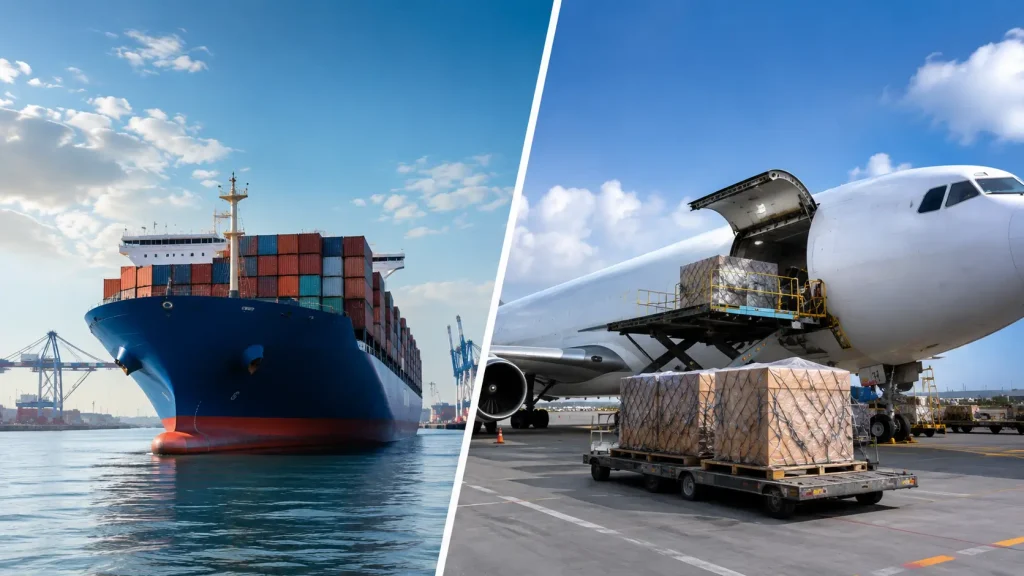
Sea is cheaper and slower, and it leaves your goods exposed for longer. Fluent Cargo shows about 36 days as the quickest container ship option for this lane.
| Point | Sea freight | Air freight |
|---|---|---|
| Typical time, Australia to Nigeria | 5 to 9 weeks (Pack & Send) | 4 to 8 business days express, 8 to 14 standard (Pack & Send) |
| Carrier liability | Weight-based, the lowest of the main modes (DHL) | Much higher: DHL’s example is about US$70,000 against about US$8,000 by sea |
| Insurance premium | Percentage of insured value, rate varies by mode and goods (no public figure by mode found) | Same method, confirm with your insurer |
| Best for | Heavy goods, barrels, flexible timing | Urgent or high-value light goods |
How do you buy cargo insurance and make a claim?
Arrange it when you book, not after. Here is the order that works.
- Work out the insured value: invoice, freight and about 10%.
- Ask for a quote before booking. A forwarder usually holds most of the paperwork a claim needs, which makes claims easier.
- Check the clause level, general average, deductible and exclusions.
- Pack for a long sea voyage and photograph the contents before sealing.
- Keep the bill of lading, commercial invoice and packing list.
- On delivery, inspect before signing, note damage on the paperwork, take photos and report it at once.
- If you booked cover separately, collect the documents from each provider yourself and file the claim.
What mistakes leave shippers uncovered?
- Insuring half the value to save a few dollars.
- Assuming the shipping line’s liability is insurance.
- Packing barrels loosely, then finding “poor packing” excluded.
- Skipping the question of Nigeria’s local insurer rule.
How can you track a shipment and spot problems early?
Track by container or bill of lading number and check status at least weekly. A long stall at a transfer port, or a late discharge at Lagos, is your cue to ask your forwarder and insurer what to document. Port delays vary month to month, so ask Postkodes for current conditions. You can track your shipment any time.
FAQ
How much does cargo insurance cost for an international shipment?
Sources put marine cargo insurance at roughly 0.1% to 2% of insured value, with many general shipments near 0.5%. A US$10,000 shipment would often cost around US$50 to US$60. Minimum premiums can apply on small shipments.
Is cargo insurance compulsory when shipping to Nigeria?
Nigerian law requires imports to be insured with a registered Nigerian insurer, and that rule remains under the 2025 reform act. Enforcement has been uneven. Ask your Nigerian consignee or clearing agent how it applies before you ship.
Does the shipping line pay if my goods are damaged?
Only up to a weight-based limit, and only if you can prove fault. Under Hague-Visby that is SDR 2 per kilo or SDR 666.67 per package, whichever is higher. Poor packing is usually the shipper’s responsibility, so claims can fail.
Can I buy cargo insurance after my goods have sailed?
Usually not, and you should not count on it. Insurers normally want cover in place before the goods leave. Arrange it when you book, and get the start date of cover in writing.
What happens if I only insure part of the value?
You may recover only part of a loss. MoneyGeek’s example: insuring US$50,000 on goods worth US$100,000 returns about half of a claim. Insure the full value plus freight.
Is cargo insurance worth it for a single barrel or small parcel?
It depends on what you would lose. If the contents are hard to replace, insure them. Small shipments can face a minimum premium, so ask for a quote and compare it with the value of the goods.
Takeaways before you book
Cargo insurance costs little next to the loss it covers. Carrier limits are set by weight, general average can bill you even when your goods are fine, and Nigeria has its own local insurance rule. Insure the full value, read the exclusions and keep your papers. When you’re ready, you can get a shipping quote from Postkodes.