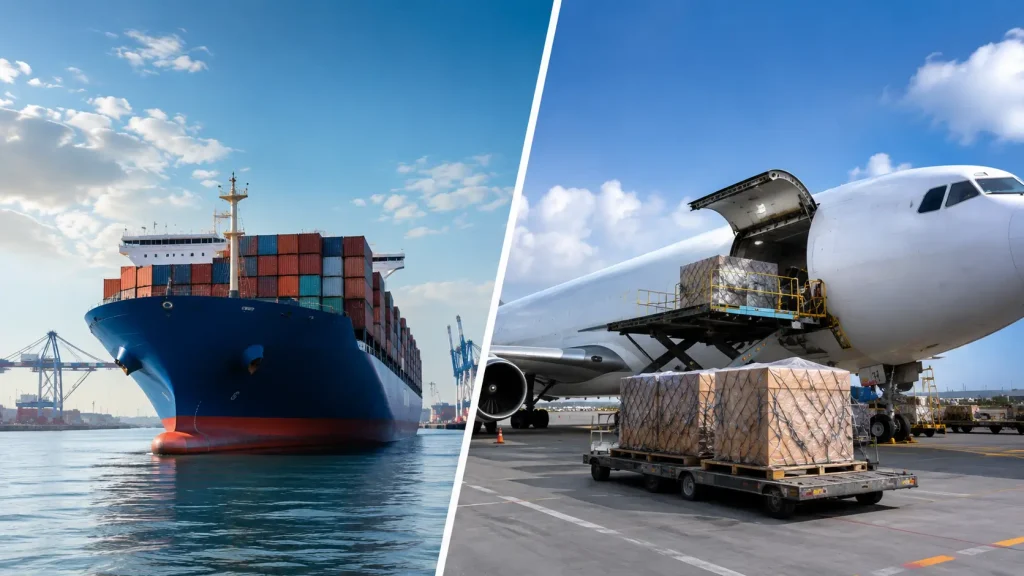

Landed cost is the full price of getting goods to your door: the product, freight, insurance, duties, taxes, port and clearance fees, and delivery. A shipping quote usually covers only part of that. Duties, taxes, storage, inspection fees and local delivery are the usual gaps, so add them before you set a price.
What is landed cost?
Landed cost is the full cost of getting a product from your supplier to your door. It includes the product price, freight, insurance, duties and taxes, customs and port fees, and delivery.
A simple formula is: product cost plus freight plus insurance plus duties and taxes plus brokerage and port fees plus inland delivery plus any other costs. Divide the total by the number of units you can sell, and you get your landed cost per unit. That per unit number is the one to use when you set prices.
What does a shipping quote usually include?
Usually the freight and its surcharges, and sometimes handling at one or both ends. It is rarely the whole journey. A port to port quote stops at the port. A door to door quote goes further, but it may still leave out duties and taxes. Always ask what is included and excluded, and get the answer in writing.
What costs does a shipping quote usually leave out?
These are the lines that most often appear after the quote, not on it:
- Import duty and taxes such as GST or VAT
- Customs brokerage or clearance fees, when they aren’t itemised
- Inspection or X-ray fees if customs selects your cargo
- Destination handling, the delivery order and LCL deconsolidation, where they aren’t included
- Storage, demurrage and detention if cargo stays too long (demurrage is the fee when a container sits at the port beyond its free days)
- Cargo insurance, unless you buy it
- Delivery from the port to your warehouse, on port to port quotes
- Bank and currency conversion fees
- Surcharges announced after the quote date
How are import duty and tax worked out?
Duty is the customs value multiplied by the duty rate, and tax is added on top. The customs value is the value customs starts from, usually based on your invoice price. The rate depends on the HS code, the country of origin and any trade agreement. Because the invoice is the starting point, it has to be accurate. Our guide to commercial invoices and packing lists shows what it should contain.
Countries don’t agree on whether freight and insurance count toward duty. Many, including the EU, the UK, India and Nigeria, base duty on the CIF value, which includes freight and insurance. Australia and the United States base duty on a value that leaves international freight and insurance out.
Tax can still include them. In Australia, GST is 10 percent of the value of the taxable importation, which is the customs value plus duty plus international transport plus insurance, according to the Australian Taxation Office. With illustrative numbers: a customs value of 10,000, duty of 500, freight of 1,000 and insurance of 100 gives a taxable value of 11,600 and GST of 1,160.
In Nigeria, VAT of 7.5 percent applies to a base that includes the CIF value, the duty and certain levies. Levy rates change, so confirm current figures with Postkodes before you budget.
How do Incoterms change your landed cost?
An Incoterm decides who pays for freight, insurance and import costs, so it decides which costs land on you. Under FOB, you pay freight, insurance and import costs. Under CIF, the seller arranges freight and insurance to the destination port, but you still pay import duties and taxes. Under DDP, the supplier builds nearly everything into the price, so your landed cost is the DDP price plus any delivery beyond the agreed point.
Compare supplier prices on the same Incoterm. Otherwise the numbers will mislead you.
What does a landed cost calculation look like?
Here is an example with illustrative numbers only, not Postkodes rates. You buy 1,000 units at 8 each, and GST is calculated using the Australian method above.
| Cost line | Illustrative amount | Usually on a freight quote? |
|---|---|---|
| Product (1,000 units at 8) | 8,000 | No, it is the supplier’s invoice |
| International freight and surcharges | 1,800 | Yes |
| Cargo insurance | 80 | Only if you buy it through the quote |
| Import duty (5 percent of customs value) | 400 | No |
| GST (10 percent of customs value plus duty, freight and insurance) | 1,028 | No |
| Customs brokerage and clearance | 150 | Sometimes |
| Destination port handling | 250 | Sometimes |
| Delivery to your warehouse | 300 | Only on door to door quotes |
| Total landed cost | 12,008 |
The freight quote shows 1,800. The landed cost is 4,008 above the product price, so freight is less than half of the extra cost. Your landed cost per unit is about 12.01, against a supplier price of 8.00.
If your business can claim the GST back, leave the 1,028 out of landed cost, which brings it to 10,980 or about 10.98 per unit. You still need the cash to pay it at the border.
What mistakes make landed cost higher than expected?
- Pricing from the supplier invoice plus freight, and forgetting duties, taxes and port fees.
- Comparing supplier prices on different Incoterms.
- Using the wrong HS code, which can mean the wrong duty rate or a customs hold.
- Ignoring free days, so storage or demurrage charges build up.
- Not asking whether destination handling and customs clearance are in the quote.
- Leaving out currency moves and bank fees on a large payment.
How do you estimate landed cost before you ship?
Work through these steps before you agree a purchase order or a selling price.
- Confirm the Incoterm with your supplier.
- Get an itemised freight quote that shows destination charges. You can start with Postkodes’ shipping calculator for a quick estimate of freight rates.
- Confirm the HS code and the duty rate for your destination.
- Work out the customs value, and check whether your destination includes freight and insurance in the duty base.
- Add taxes, and decide whether you can recover them.
- Add brokerage, port handling, inspection risk and delivery to your warehouse.
- Divide the total by your sellable units.
- Add a buffer for surcharges or rate changes announced after the quote.
Frequently asked questions
What is landed cost in shipping?
Landed cost is the total cost of getting goods from the supplier to your door. It includes the product price, freight, insurance, duties, taxes, customs and port fees, and delivery. Dividing it by the number of sellable units gives your landed cost per unit.
What is not included in a freight quote?
Quotes often exclude import duties and taxes, inspection fees, storage, demurrage and detention, cargo insurance, and delivery to your door. Some also exclude destination handling and customs clearance. Ask for every inclusion and exclusion in writing before you accept.
Is import duty charged on freight?
It depends on the country. Many countries, including those in the EU, UK, India and Nigeria, base duty on the CIF value, which includes freight and insurance. Australia and the United States base duty on a value that excludes international freight and insurance.
Is GST or VAT part of landed cost?
Only if you can’t recover it. Many registered businesses claim import GST or VAT back, so they leave it out of landed cost. You still need the cash to pay it at the border, so include it when you plan payments.
How do Incoterms change landed cost?
Incoterms decide who pays for freight, insurance and import costs. Under FOB the buyer pays freight, insurance and import costs. Under CIF the seller pays freight and insurance to the port, but you still pay duties and taxes. Under DDP the supplier includes nearly everything in the price.
How can I reduce landed cost?
Check the HS code is correct, compare itemised quotes on the same terms, choose LCL or FCL by volume, and avoid storage charges by clearing quickly. Tighter packaging also lowers air freight cost, since air freight is billed on chargeable weight.
What should you do next?
Before you agree a selling price, build your landed cost per unit using the steps above. Treat the freight quote as one line of the bill, not the whole bill.
When you’re ready for a price, request an estimate through Postkodes’ Quick Quote page and ask what is included and what is excluded.